

Every business that reports to FINTRAC must appoint a compliance officer, but the law does not say that person has to sit on your payroll five days a week. Two service models have grown up in that space: the fractional CAMLO and outsourced AML compliance. Providers often use the two terms as if they meant the same thing. They do not, and choosing the wrong one can leave you paying for work you do not need or, worse, with an accountable role that nobody is really filling. This guide explains what each model covers, what each costs, how FINTRAC looks at them and how to decide which one fits your business.
Key Takeaways
- A fractional CAMLO is a named senior person who holds your compliance officer role part-time. Outsourced AML compliance is a team that carries out compliance tasks for you.
- FINTRAC’s guidance focuses on the officer’s authority, knowledge and resources. It does not require a full-time employee.
- You can hand over the work, but your business stays responsible to FINTRAC for its own compliance program.
- Since 26 March 2026, maximum penalties are up to 40 times higher, so an officer who exists only on paper is a direct financial risk.
- Most growing firms use both models together and move roles in-house as volume increases.
Why This Decision Matters More in 2026
The enforcement picture has changed sharply. According to FINTRAC’s Annual Report 2025-26, the Centre issued 35 notices of violation in the fiscal year, up 52% from the year before, for more than $247 million in penalties. The previous year’s total was about $25 million. One penalty alone, $176 million against Xeltox Enterprises Ltd. (operating as Cryptomus), was the largest in FINTRAC’s history, and nine money services businesses accounted for more than $198 million between them.
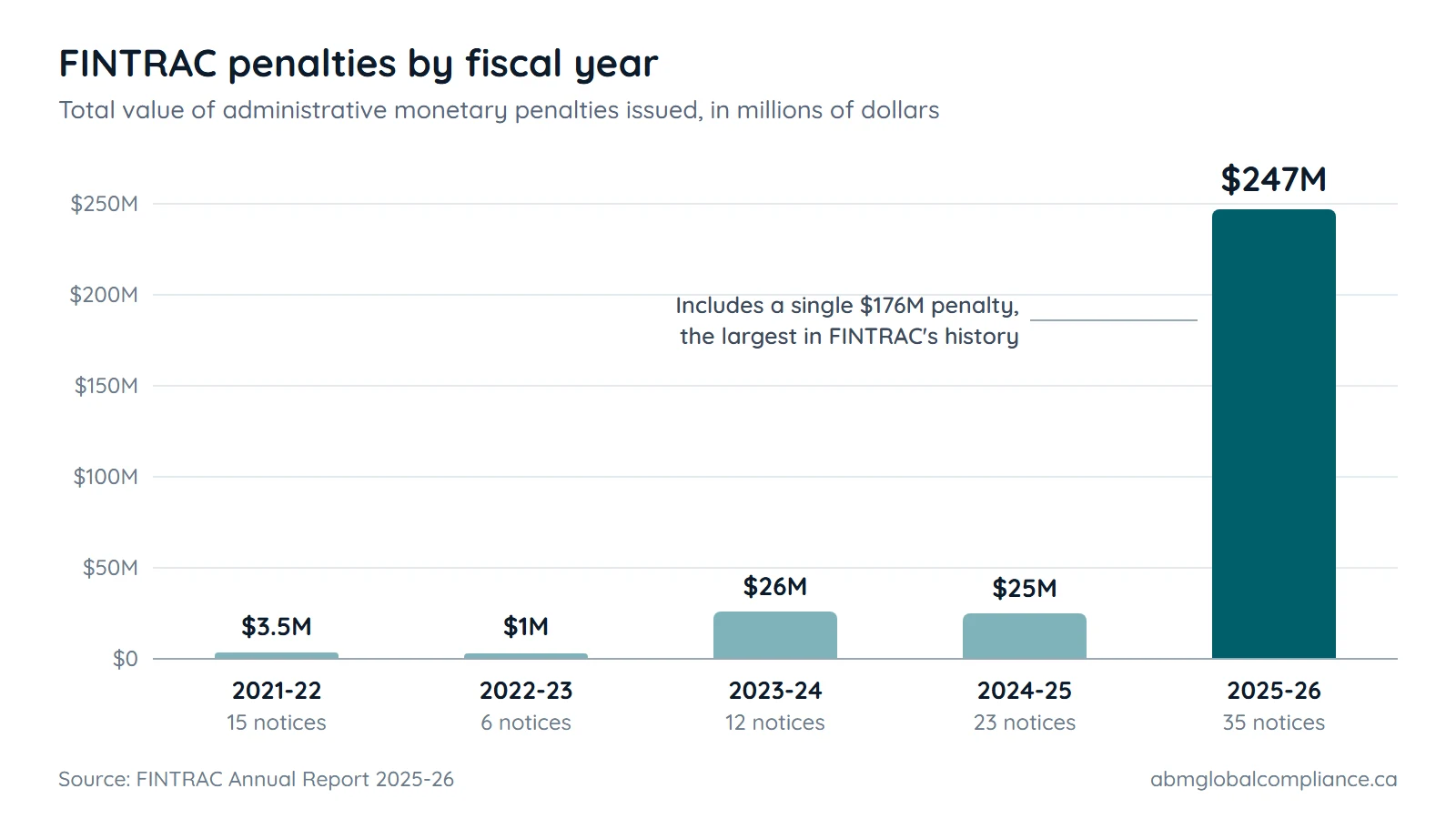
Supervision is also wider. FINTRAC carried out 625 targeted examinations and information demands in 2025-26, 433 of them on money services businesses, and revoked 82 MSB registrations compared with 12 a year earlier.
Then the law itself tightened. The Strengthening Canada’s Immigration System and Borders Act (Bill C-12) received Royal Assent on 26 March 2026. It raised maximum administrative monetary penalties to as much as 40 times their previous level: up to $40,000 for a minor violation, $4 million for a serious one and $20 million for a very serious one. It also made it a very serious violation to operate a compliance program that is not reasonably designed, risk-based and effective.
In practical terms, whoever holds the compliance officer role, in-house or external, now has to be able to show that the program works. Our article on how MSBs can prepare for regulatory scrutiny looks at what examiners expect to see.
What FINTRAC Requires of a Compliance Officer
The Proceeds of Crime (Money Laundering) and Terrorist Financing Act (PCMLTFA) requires every reporting entity to run a compliance program. FINTRAC’s compliance program guidance sets out its elements: an appointed compliance officer, written policies and procedures, a risk assessment, an ongoing training program and plan, and an effectiveness review at least every two years. If the wider framework is new to you, our overview of AML compliance basics and regulations is a good place to start.
On the officer specifically, the guidance is built around capability, not employment status. The officer must have:
- the authority and access to resources needed to implement the program and make changes to it
- knowledge of your business functions and structure
- knowledge of the money laundering, terrorist financing and sanctions evasion risks in your sector
- knowledge of your obligations under the Act and its regulations
Three further points from the guidance shape the fractional versus outsourced decision:
- Appointment alone is not compliance. Naming an officer does not satisfy the requirement. The officer is responsible for implementing every element of the program.
- Duties can be delegated, responsibility cannot. The officer may hand tasks to others but remains responsible for the program.
- Independence is a best practice. The officer should be able to communicate directly with senior management or the board, and in larger businesses should not be directly involved in receiving, transferring or paying funds.
Nothing in that list calls for a full-time employee. A sole proprietor can appoint themselves, a small business can appoint its owner, and many MSBs and payment firms appoint an external professional. What does not change is where liability sits: the reporting entity stays answerable to FINTRAC for its own program, whoever runs it.
What Is a Fractional CAMLO?
CAMLO stands for Chief Anti-Money Laundering Officer. The title comes from the banking sector. The PCMLTFA itself only speaks of a compliance officer, but CAMLO has become a common label in Canada for the senior person who owns the AML program. In the UK and many other jurisdictions the equivalent role is the Money Laundering Reporting Officer (MLRO), which is why cross-border firms use both terms.
A fractional CAMLO is a named, senior individual who takes on that role for a set portion of the week or month. Three features define the model:
- A named person is appointed. They are designated as your compliance officer and act as the contact for FINTRAC, your bank and your auditors.
- They sit inside your governance. They attend management meetings, report to the board and sign off on policies, risk assessments and suspicious transaction decisions.
- Time is limited, accountability is not. You are buying a share of an experienced officer’s time, usually a fixed number of days per month, with the same responsibility a full-time officer would carry.
The model suits firms that need senior judgement and a credible face for regulators and banking partners but do not have the volume to justify a full-time executive. Our outsourced MLRO services are structured this way, from an ongoing retainer to interim MLRO cover when an officer leaves unexpectedly.
What Is Outsourced AML Compliance?
Outsourced AML compliance is broader. Instead of one appointed individual, a provider’s team delivers some or all of the operational work of your program under a service agreement. Typical scope includes:
- client identification and KYC reviews
- transaction monitoring and alert handling
- preparing and filing suspicious transaction reports, large cash transaction reports and electronic funds transfer reports
- keeping policies and procedures current as the rules change
- delivering staff training
- record keeping and tracking regulatory change
The key difference is that outsourcing covers functions, not necessarily the appointed role. You can outsource the daily work and keep an internal compliance officer who directs it. You can also combine the two, with an outsourced compliance officer supported by an outsourced compliance department. What you cannot do is outsource the work and leave the officer role vacant or nominal.
Fractional CAMLO vs Outsourced AML Compliance: Key Differences
| Factor | Fractional CAMLO | Outsourced AML Compliance |
|---|---|---|
| What you get | A named senior officer for a fixed share of time | A team delivering defined compliance tasks |
| Core purpose | Leadership, oversight and accountability | Operational capacity and execution |
| Appointed compliance officer | Yes, the individual holds the role | Only if the agreement includes it |
| Typical work | Program ownership, risk decisions, STR sign-off, board reporting, regulator liaison | KYC, monitoring, report filing, policy upkeep, training delivery |
| Role in a FINTRAC examination | Direct point of contact | Supplies records and evidence to the officer |
| Scales with | Complexity and risk | Transaction and client volume |
| Best for | Firms with staff to do the work but no senior AML lead | Firms with a lead but not enough hands, or with neither |
| Main risk | Too little time allocated for the size of the business | Tasks completed without anyone owning the outcome |
The two models work well together. Many growing firms start with a fractional CAMLO, add outsourced functions as volumes rise and bring roles in-house once the scale justifies it.
How Much Does Each Model Cost?
Cost is usually the reason the question comes up, so it helps to start with the in-house benchmark. PayScale’s 2026 figures put the average base salary for a chief compliance officer with AML skills at about C$147,000 in Toronto and around C$151,000 for late-career professionals across Canada. Benefits, bonus, training, software and cover for absences sit on top of that. A smaller firm also carries key-person risk: when a single in-house officer resigns, the program has no owner until a replacement is found.
External models are priced differently:
- Fractional CAMLO: normally a monthly retainer tied to days of senior time. Published Canadian market estimates for a fractional or outsourced compliance officer generally fall between about $2,000 and $8,000 per month, with higher-risk and higher-volume businesses at the upper end or above it.
- Outsourced AML compliance: usually priced by scope and volume, for example the number of clients onboarded, alerts reviewed or reports filed, sometimes with a one-time setup fee for policies and systems.
Treat any range as indicative. The real cost drivers are:
- transaction volume and the number of clients
- products and channels, since virtual currency and cross-border remittance need more monitoring
- the countries you send to and receive from
- the state of your current program, because remediation costs more than maintenance
- how much reporting your board, bank and payment partners expect
A useful test is to compare each quote against the hours it buys. A very low retainer usually means very few hours, and under the standard introduced by Bill C-12 an officer without enough time to do the job is a liability, not a saving.
Which Model Fits Your Business?
Newly registered MSBs and PSPs. A fractional CAMLO is usually the first step. Banks and payment partners will ask who your compliance officer is before they onboard you, and a named, experienced person answers that question. If you are still at the application stage, our guide on how to register as a money services business with FINTRAC explains where the compliance officer fits in.
Scaling fintechs and virtual currency businesses. Alert and reporting volumes soon outgrow one part-time person. Keep the CAMLO for oversight and outsource monitoring, KYC reviews and report preparation.
Credit unions and smaller financial entities. These firms usually have governance and staff but limited specialist depth. Financial entities received 12 of the 35 notices of violation FINTRAC issued in 2025-26, more than any other sector, so targeted compliance support for credit unions can close gaps without adding headcount.
Foreign businesses serving Canadian clients. A foreign MSB needs someone who knows Canadian requirements in detail. A Canada-based fractional CAMLO gives the head office compliance team that local knowledge.
Firms facing an examination or fixing past findings. This is where both models are needed at once: senior leadership to deal with the regulator and extra hands to clear the backlog. Early FINTRAC examination preparation makes a measurable difference to the outcome.
Questions to Ask Before You Sign
- Who exactly will be appointed? Ask for the individual’s name, sector experience and qualifications such as CAMS.
- How many hours or days are committed each month? Ask what happens when volume spikes or an examination begins.
- How many other firms does the officer serve? An officer spread across too many clients cannot give any of them real oversight.
- Who decides on suspicious transactions? Be clear about who reviews alerts, who makes the decision to report and who files.
- How will the officer report upward? Regular board and senior management reporting is the evidence that oversight is real.
- Who carries out the two-year review? FINTRAC’s guidance says, as a best practice, that the review should not be done by someone directly involved in running the program. If one provider supplies your officer, ask how it keeps the independent effectiveness review separate.
- How do the officer and your staff stay current? Rules changed several times in 2025 and 2026, so ask about ongoing AML training for compliance officers and front-line teams.
- What happens when the engagement ends? Agree in advance on the notice period, the handover and who keeps the records.
Common Mistakes to Avoid
- A name on paper. An appointed officer who never reviews files, attends meetings or reports to management will not satisfy an examiner.
- Buying on price alone. The cheapest retainer rarely includes enough senior time for a business with real transaction volume.
- Assuming responsibility transfers. A service agreement moves the work to the provider. It does not move your obligations under the PCMLTFA.
- Generic templates. Policies copied from a template do not reflect your clients, products or corridors. The program has to follow from a documented AML risk assessment of your own business.
- No record of oversight. Keep minutes, reports and sign-offs. If oversight is not documented, you cannot prove it happened.
How ABM Global Compliance Canada Can Help
ABM Global Compliance Canada provides both models. We can act as your appointed compliance officer on a fractional basis, run defined compliance functions for you, or combine the two as your business grows. Every engagement starts with a review of your current program, so the scope reflects your actual risk and volume. To talk through which model fits your business, book a consultation with our team.
Frequently Asked Questions
Can a compliance officer be outsourced in Canada?
FINTRAC’s guidance does not require the compliance officer to be an employee. It requires the officer to have the authority, resources and knowledge to implement the compliance program. Many reporting entities appoint an external professional on that basis. The business itself remains responsible for meeting its obligations.
What is the difference between a CAMLO and an MLRO?
They describe the same kind of role. CAMLO, or Chief Anti-Money Laundering Officer, is the title commonly used in Canada. MLRO, or Money Laundering Reporting Officer, is the term used in the UK and many other jurisdictions. Canadian law itself refers simply to a compliance officer.
How much does an outsourced CAMLO cost?
Most providers charge a monthly retainer based on the senior time required. Published market estimates in Canada generally range from about $2,000 to $8,000 per month, depending on transaction volume, risk profile and the scope of work. A full-time chief compliance officer with AML skills earns about C$147,000 in base salary in Toronto, according to PayScale’s 2026 data.
Does FINTRAC require a full-time compliance officer?
No. The requirement is to appoint a compliance officer who is responsible for implementing the program. The time needed depends on the size, complexity and risk of the business. What matters is that the officer has enough time and authority for the program to be effective.
Who is responsible if an outsourced compliance officer makes a mistake?
The reporting entity is. Outsourcing changes who does the work, not who answers to FINTRAC. This is why the service agreement, regular management reporting and an independent effectiveness review are so important.